Products | Zivimox-D
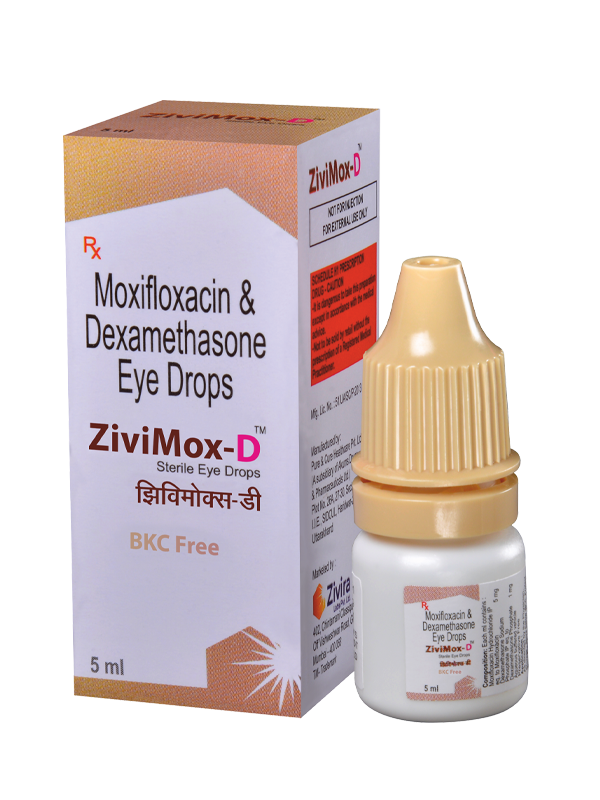
5ML
ZiviMox-D
Moxifloxacin & Dexamethasone Eye Drops
Zivimox-D Eye Drops is indicated for steroid-responsive inflammatory ocular conditions for which a corticosteroid is indicated and where bacterial infection or a risk of bacterial ocular infection exists.
Composition:
Each ml contains:
Moxifloxacin Hydrochloride IP eq. to Moxifloxacin 5 mg
Dexamethasone Sodium Phosphate IP eq. to Dexamethasone Phosphate 1 mg
Aqueous Buffered vehicle q.s.
(Solution Preserved with Ionic Solvent)
Description:
Zivimox-D Eye Drops is a sterile, isotonic ophthalmic solution which combines moxifloxacin hydrochloride and dexamethasone sodium phosphate. The instillation of a combination steroid and antibiotic is beneficial to patients in the following ways: The steroid suppresses the inflammation while the antibiotic controls the proliferation of potential susceptible pathogenic bacteria and also works prophylactically.
Indication:
Zivimox-D Eye Drops is indicated for steroid-responsive inflammatory ocular conditions for which a corticosteroid is indicated and where bacterial infection or a risk of bacterial ocular infection exists. The combination can also be used for post-operative inflammation and any other ocular inflammation associated with infection.
Mechanism of Action:
Zivimox-D sterile ophthalmic solution contains the antibiotic moxifloxacin hydrochloride, which destroys the susceptible bacteria that cause ocular infection, and the anti-inflammatory dexamethasone phosphate (steroid).
Contraindications:
Zivimox-D Eye Drops is contraindicated in epithelial herpes simplex keratitis, varicella, and in many other viral disease of the conjunctiva and cornea, Mycobacterial infection of the eye and fungal diseases of ocular structures and in individuals hypersensitive to any of the components of the medication.
Storage:
Store below 25°C. Protect from light & moisture. Do not freeze.
Keep out of reach of children.
Prevention of Post-Surgery Ocular Inflammation and Infection: Instill 1 drop, 4 times/day in the eye to be operated, starting 1 day before the surgery until 15 days after the surgery.
Treatment of Ocular Infections Caused by Susceptible Organisms:
Instill 1 drop 4 times/day during 7 days, or as directed by the doctor.
Do not use outdated medicine. Observe the appearance of the medicine before using it.
Patients Submitted to Cataract Surgery: Instill the solution immediately after the surgery.
Patients Submitted to Refractive Surgery by LASIK: Instill the solution beginning 15 min after the surgery or as directed by the Physician.
Administration: To prevent contaminating the nozzle tip and solution, care should be taken not to touch any surface with the tip of the vial. Doctor's instructions on the schedule, dose and duration of treatment should be followed. Do not discontinue treatment without consulting the doctor.
If an allergic reaction to moxifloxacin occurs, discontinue use of Zivimox-D Eye Drops and contact the doctor.
Prolonged steroid use may result in ocular hypertension and/or glaucoma with damage to the optic nerve, defect in visual acuity and fields of vision, posterior subcapsular cataract formation, or increased hazard of developing secondary ocular infections.
The intraocular pressure must be evaluated routinely.
In those diseases causing thinning of the cornea or sclera (white part of the eye) perforations have been known to occur with use of topical corticosteroids.
In acute purulent conditions of the eye, steroids may mask infection or enhance existing infection.
Use the solution within one month after opening the container. If the solution becomes cloudy or dark brown, it should be discarded.
NOT FOR INJECTION. FOR EXTERNAL USE ONLY.
Zivimox-D Eye Drops should not be injected sub-conjunctivally, nor should it be introduced directly into the anterior chamber of the eye.
Pharmacodynamics:
The mechanism of action of moxifloxacin (and other fluoroquinolone antimicrobials) involves the inhibition of bacterial topoisomerase IV and deoxyribonucleic acid (DNA) gyrase enzymes required for DNA replication, transcription, repair, and recombination.
In gram-negative bacteria, fluoroquinolones preferentially target DNA gyrase rather than topoisomerase IV. Whereas in gram-positive bacteria, the target specificity is reversed.
Moxifloxacin has been shown to be active against most strains of the following microorganisms, both in-vitro and in clinical infections.
Aerobic Gram-Positive Microorganism: Corynebacterium sp*, Micrococcus luteus*, Staphylococcus epidermidis, Staphylococcus haemolyticus, Staphylococcus hominis, Staphylococcus warneri*, Streptococcus pneumoniae, Streptococcus viridans group.
Aerobic Gram-Negative Microorganisms: Acinetobacter lwoffii*, Heamophilus influenzae, Haemophilus parainfluenzae*.
Corticosteroids achieve their anti-inflammatory effects through decreased release of arachidonic acid as well as suppression of vascular endothelial cell adhesion molecules, cyclooxygenase and cytokine expression.
This action results in a reduced release of pro-inflammatory mediators and reduced adhesion of circulating leukocytes to vascular endothelium, preventing their passage into inflamed ocular tissue.
Additionally, decreased expression of cyclooxygenase results in a decreased production of inflammatory prostaglandins, which are known to cause breakdown of the blood aqueous barrier and leakage of plasma proteins into the ocular tissue.
- Efficacy for this organism was studied in fewer than 10 patients with infection.
Overdosage:
In case of excessive instillation in the eye, rinse with sufficient warm water. Do not instill the product again until the time of the next dose.
Special Precautions:
General: As with other antibiotic preparations, prolonged use may result in overgrowth of non-susceptible organisms, including fungi. If superinfection occurs, appropriate therapy should be initiated.
Whenever clinical judgment dictates, the patient should be examined by biomicroscopy and, where appropriate, fluorescein staining.
The possibility of fungal infections of the cornea should be considered after long-term steroid dosing.
Use in Pregnancy & Lactation:
There are no adequate and well-controlled studies in pregnant women. Zivimox-D Eye Drops should be used during pregnancy only if the potential benefit justifies the potential risk to fetus.
It is not known whether topical administration of corticosteroids could result in sufficient systemic absorption to produce detectable quantities in human milk. Many drugs are excreted in human milk, thus caution should be exercised when Zivimox-D Eye Drops is administered to a nursing mother.
Use in Children:
Safety and effectiveness in pediatric patients have not been established.
Use in the Elderly:
No changes of dose are required for elderly patients.
Undesirable Effects:
The adverse reactions that may occur with use of corticosteroids are: Glaucoma with optic nerve damage, visual acuity defects and visual field defects; cataract formation; secondary ocular infection following suppression of host response; and perforation of the globe.
The most frequent ocular adverse effects reported with the use of moxifloxacin ophthalmic solution 0.5% were conjunctivitis, decreased visual acuity, dry eye, keratitis; ocular discomfort, ocular hyperemia, ocular pain and ocular pruritus, subconjunctival hemorrhage, and tearing.
These events occurred in approximately 1-6% of patients. In surgical procedures, some of these events are consequence of the surgery.
Non-ocular adverse events reported at a rate of 1-4% were fever, increased cough, infection, otitis media, pharyngitis, rash and rhinitis.
Drug Interactions:
Drug-durg interaction studies have not been conducted with Zivimox-D Eye Drops.
In vitro studies indicate that moxifloxacin does not inhibit CYP3A4, CYP2D6, CYUP2C9, CYP2C19 or CYP1A2, indicating that moxifloxacin is unlikely to alter the pharmacokinetics of drugs metabolized by these cytochrome P450 isozymes.
Based on findings from systemic administration studies, corticosteroids may increase the activity of barbiturates, tricyclic antidepressants and decrease the activity of anticholinesterase agents, salicylates and anticoagulants.
The relevance of these observations for the ophthalmic administration had not been studied.
Presentation:
Zivimox-D Eye Drops is available in 5 ml container.