Products | ZiviMox-LP
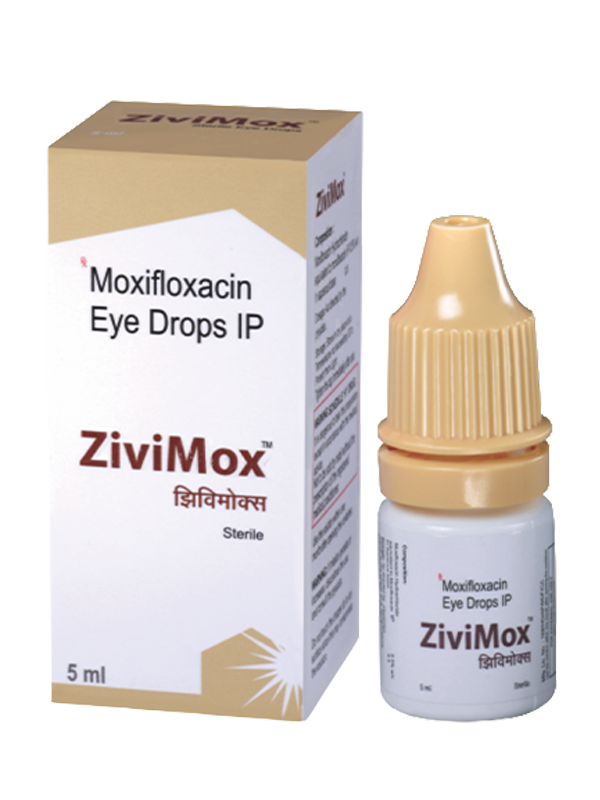
5ML
ZiviMox-LP
Moxifloxacin Hydrochloride & Loteprednol Ophthalmic Suspension
For steroid-responsive inflammatory ocular conditions including postoperative conditions where a corticosteroid is indicated and where superficial bacterial ocular infection or a risk of bacterial ocular infection exists. Also indicated for treatment of bacterial conjunctivitis.
Composition:
Moxifloxacin
Hydrochloride IP
eq. to Moxifloxacin 0.5% w/v
Loteprednol Etabonate 0.5% w/v
Sterile Aqueous Base q.s.
Indications and Usage:
For steroid-responsive inflammatory ocular conditions including postoperative for which a corticosteroid is indicated and where superficial bacterial ocular infection or a risk of bacterial ocular infection exists.
Moxifloxacin is active against Corynebacterium species*
Micrococcus luteus*, Staphylococcus aureus, Staphylococcus epidemidis, Staphylococcus haemolyticus, Staphylococcus hominis, Staphylococcus warneri*, Streptococcus pneumonia, Streptococcus viridiansgroup, Acinetobacter Iwoffii*, Haemophilus intluenza, Haemophilus parainfluenzae* Chlamydia trachomatis & *Efficacy for this organism was studied in fewer than 10 intections.
For the treatment of patients with bacterial conjunctivitis.
Dosage and Administration:
The recommended dosage regimen for patients one year of age and older is one drop in the affected eye(s) 3 times a day.
Contraindications:
ZiviMox-LP is contraindicated in individuals with known or suspected hypersensitivity to any of the ingredients of this preparation and to other corticosteroids. ZiviMox-LP is contraindicated in most viral diseases of the cornea and conjunctiva including epithelial herpes simplex keratitis (dendritic keratitis). Vaccinia, and varicella, and also in mycobacterial infection of the eye and fungal diseases of ocular structures.
Storage:
Store below 30°C. Protect from light & moisture. Do not freeze.
- ZiviMox-LP Eye Drops should not be injected subconjunctivally, nor should it be introduced directly into the anterior chamber of the eye.
- Exposure to Glaucoma Patients: Prolonged use of Loteprednol may result in glaucoma with damage to the optic nerve, defects in visual acuity and fields of vision, and in posterior subcapsular cataract formation. Steroids should be used with caution in the presence of glaucoma.
- Increase in chances of secondary infections: Prolonged use of Loteprednol or other corticosteroids may suppress the host response and thus increase the hazard of secondary ocular infections. In acute purulent conditions of the eye, steroids may mask infection or enhance existing infection.
- Exposure to patient suffering from viral infection: Use of ocular steroids may prolong the course and may exacerbate the severity of many viral infections of the eye (including herpes simplex). Employment of a corticosteroid medication in the treatment of patients with a history of herpes simplex requires great caution.
- Exposure to patient after cataract surgery: The use of Loteprednol after cataract surgery may delay healing and increase the incidence of bleb formation. In general patients should not wear contact lenses after cataract surgery, unless contact lens wearing is medically indicated.
- Contact with soft contact lenses should be avoided. Patients should be advised to remove contact lenses prior to application and wait at least 15 minutes before reinsertion. Known to discolour soft contact lenses.
- Patients receiving systemic quinolones: In patients receiving systemically administered quinolones, serious and occasionally fatal hypersensitivity (anaphylactic) reactions have been reported, some following the first dose of Moxifloxacin. Some reactions were accompanied by cardiovascular collapse, loss of consciousness, angioedema and itching.
- Shake well before use.
- Use the suspension within one month after opening the container.
- NOT FOR INJECTION. FOR EXTERNAL USE ONLY.
Special Population:
Pregnancy: Since there are no adequate and well-controlled studies in pregnant women ZiviMox-LP suspension should only be used during pregnancy if the potential benefit justifies the potential risk to the fetus.
Nursing Mothers: Moxifloxacin is excreted in the breast milk of rats following oral and intravenous administration. Because of the potential for unknown effects from moxifloxacin in infants being nursed by mothers taking ZiviMox-LP suspension, a decision should be made to either discontinue nursing or discontinue the administration of ZiviMox-LP.
Pediatric Use: Safety and effectiveness of ZiviMox-LP in pediatric patients have not been established.
Geriatric: No overall differences in safety and effectiveness have been observed between elderly and other adult patients.
Renal Impairment: The pharmacokinetic parameters of oral moxifloxacin are not significantly altered by mild, moderate or severe renal impairment. No dosage adjustment of ZiviMox-LP Eye Drops is necessary in patients with renal impairment.
Clinical Pharmacology:
MOXIFLOXACIN
Mechanism of Action
The antibacterial action of moxifloxacin results from inhibition of topoisomerase II (DNA gyrase) and topoisomerase IV. DNA gyrase is an essential enzyme that is involved in the replication, transcription and repair of bacterial DNA. Topoisomerase IV is an enzyme known to play a key role in the partitioning of the chromosomal DNA during bacterial cell division.
Pharmacokinetics:
Plasma concentrations were studied in 21 healthy male and female subjects who were administered moxifloxacin hydrochloride ophthalmic solution to both eyes every 8 hours for a total of 13 doses. The results showed measurable plasma concentrations of moxifloxacin (>0.75 ng/mL) in 16 of 21 subjects at 4-hours following the first dose, and in all subjects following the last dose.
The mean steady-state estimates for Cmax and AUC were 2.7 ng/mL and 41.9 ng.hr/mL, respectively. The steady-state parameter estimates for Cmax and AUC were at least 1,600 and 1,000 fold lower than mean Cmax and AUC values reported after therapeutic 400 mg oral doses of moxifloxacin.
Half-Life:
The steady-state plasma half-life of moxifloxacin was estimated to be 13 hours.
Tear film concentrations of moxifloxacin were studied in 31 healthy male and female adult volunteers who were administered 1 drop of Moxifloxacin Hydrochloride solution to both eyes every 8 hours for a total of 10 doses.
Mean tear concentrations at 5 minutes following the first and last topical dose were 46.0 and 55.2 microgram/mL, respectively. Thereafter, mean tear concentrations rapidly declined in a biphasic manner with means ranging from approximately 1 to 4 microgram/mL over the 1 to 8 hour sampling period.
Pre-dose morning tear concentrations on Days 2 to 4 averaged over 4 micro gram/mL, demonstrating that concentrations are above the MICs for most of the common organisms in conjunctivitis over the 24-hour period.
Distribution
Moxifloxacin is widely distributed in the body tissues and approximately 50% is bound to serum proteins. Animal studies indicate some penetration into conjunctiva and ocular tissues with prolonged binding to melanin.
Metabolism & Excretion
Approximately 45% of an oral dose is excreted as unchanged drug, and most of the rest as glucuronide and sulfate conjugates in feces and urine. The cytochrome P450 enzyme system is not involved in metabolizing the drug.
LOTEPREDNOL
Mechanism of Action
Corticosteroids inhibit the inflammatory response to a variety of inciting agents and probably delay or slow healing. They inhibit the edema, fibrin deposition, capillary dilation, leukocyte migration, capillary proliferation, fibroblast proliferation, deposition of collagen, and scar formation associated with inflammation.
There is no generally accepted explanation for the mechanism of action of ocular corticosteroids. However, corticosteroids are thought to act by the induction of phospholipase A2 inhibitory proteins, collectively called lipocortins.
It is postulated that these proteins control the biosynthesis of potent mediators of inflammation such as prostaglandins and leukotrienes by inhibiting the release of their common precursor arachidonic acid.
Pharmacokinetics
Loteprednol is highly lipid soluble which enhances its penetration into cells. Loteprednol etabonate is synthesized through structural modifications of prednisolone-related compounds so that it will undergo a predictable transformation to an inactive metabolite.
Based upon in vivo and in vitro preclinical metabolism studies, loteprednol etabonate undergoes extensive metabolism to inactive carboxylic acid metabolites.
A bioavailability study with administration of one drop of 0.5% loteprednol in each eye eight times a day for 2 days or four times a day for 42 days found that plasma concentrations of loteprednol etabonate and its primary inactive metabolite were below the limit of quantitation at all sampling times, which suggests limited (less than 1 nanogram per mL) systemic absorption.
Metabolites extensively, to inactive carboxylic acid metabolites.
Adverse Reactions:
MOXIFLOXACIN
In clinical trials involving 1068 subjects/patients, moxifloxacin hydrochloride ophthalmic solution was administered twice-daily for three days, three-times-daily for four to fourteen days and eight-times-daily for fourteen days.
During treatment with solution, 6.6% (71 out of 1068) subjects/patients experienced treatment-related adverse drug reactions and of these only two (0.2%) discontinued study participation. No serious ophthalmic or systemic adverse reactions related to solution were reported.
Clinical Trial Adverse Drug Reactions
The most frequently reported treatment-related adverse drug reactions were transient eye irritation (3.9%) (burning and/or stinging) and eye pruritus (1.1%).
Treatment-related adverse drug reactions that occurred at an incidence of 0.1% to less than 1.0% included the following:
Eye disorders: Ocular hyperaemia, keratoconjunctivitis sicca, abnormal sensation in eye ocular discomfort, corneal epithelium defect, conjunctivitis, conjunctival haemorrhage, visual acuity reduced, eyelid oedema, eye pain.
General disorders and administration site conditions: sensation of foreign body.
Investigations: Corneal staining, alanine aminotransferase increased.
Nervous system disorders: dysgeusia, headache.
Respiratory, thoracic, and mediastinal disorders: pharyngolaryngeal pain.
LOTEPREDNOL
Reactions associated with ophthalmic steroids include elevated intraocular pressure, which may be associated with optic nerve damage, visual acuity and field defects, posterior subcapsular cataract formation, secondary ocular infection from pathogens including herpes simplex, and perforation of the globe where there is thinning of the cornea or sclera.
Ocular Events:
Ocular adverse reactions occurring in 5-15% of patients treated with loteprednol etabonate ophthalmic suspension (0.2%-0.5%) in clinical studies included abnormal vision/blurring, burning on instillation, chemosis, discharge, dry eyes, epiphora, foreign body sensation, itching, injection and photophobia.
Other ocular adverse reactions occurring in less than 5% of patients include conjunctivitis, corneal abnormalities, eyelid erythema, keratoconjunctivitis, ocular irritation/pain/discomfort, papillae, and uveitis.
Non Ocular Events
Non-ocular adverse reactions occurred in less than 15% of patients. These include headache, rhinitis and pharyngitis.
Overdose:
The limited holding capacity of the conjunctival sac for ophthalmic products practically precludes any overdosing of the medicinal product.
Drug-Interactions:
MOXIFLOXACIN
Drug-drug interaction studies have not been conducted with Moxifloxacin Hydrochloride solution. Moxifloxacin can be chelated by polyvalentions such as Mg++, Al+++, Fe++ and Zn++.
There is limited information available on the concurrent use of Moxifloxacin Hydrochloride solution and other ophthalmic products.
In vitro studies indicate that Moxifloxacin does not inhibit CYP3A4, CYP2D6, CYP2C9, CYP2C19 or CYP1A2 indicating that moxifloxacin is unlikely to alter the pharmacokinetics of drugs metabolized by these cytochrome P450 isozymes.
Storage and Handling Instructions:
Store below 30°C. Protect from light & moisture. Do not freeze. Keep out of reach of children.
NOT FOR INJECTION. FOR EXTERNAL USE ONLY. SHAKE WELL BEFORE USE.
Use the suspension within one month after opening the container.
Packaging Information:
ZiviMox-LP Eye Drops is available in a 5ml pack.